🎧 5 Career Questions: How is money like a cat?
On his fifth career, nonprofit founder shares lessons on authenticity and taking risks
👋 Interested in hosting a Career River conversation for your workplace or professional community? I'm currently accepting virtual and limited in-person speaking engagements for early 2026. Email me about setting up a workshop or other event!
Jake Hylton was sitting on his porch with one of his oldest friends when she asked him two questions that would shape the next eight years of his life.
He was working at a tech startup, which he hated, and he was stressed, exhausted, and had no idea what to do next.
"What do you care about?" his friend asked him. Hylton he wanted to help people.
"Well, what's one thing that you wish you always had help with?"
Hylton, who grew up housing insecure, said, "I wish that somebody could help me find a safe place to live." That was the moment he decided to go to real estate school, in the fourth of the five careers he's had (so far).
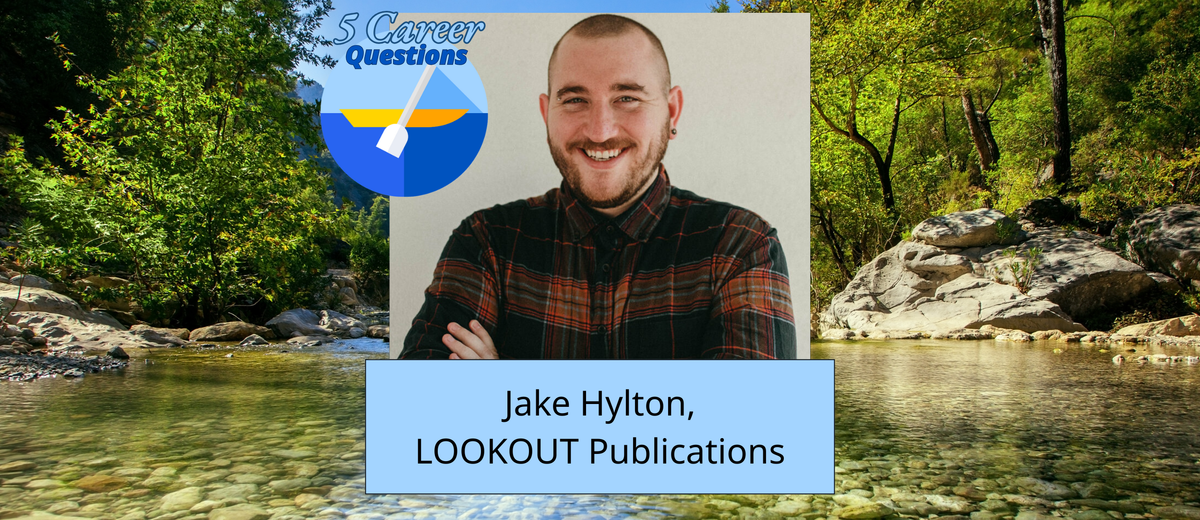
I reached out to Hylton because I was curious to learn if his queer experience had informed his career the way it has impacted mine. We got to discuss that and a whole lot more. Hylton started working at age 10 at his mom's restaurant consulting business and deli. His career has taken him from theater to tech to real estate. Today he is the the executive director of LOOKOUT Publications, an LGBTQ+ nonprofit news organization based in Arizona, which he co-founded in 2022 with his partner, Joseph Darius Jaafari, who also serves as editor-in-chief. Three 🔑 takeaways from our conversation:
- Money is like a cat. The last thing you should do is chase it – if you create the right conditions, it will come to you.
- Put people first. Creating genuine, authentic relationships is valuable no matter what line of work you're in, and it begins with accepting yourself.
- Failure isn't a speed bump. Unless something cataclysmic happens, failure should not define your choices. Small failures are learning experiences.
"I have been able to be a queer business leader doing something that no one else has really ever done, in a place where we probably shouldn't have found any success doing it," Hylton said. "But three years later, we are and we have, and there's more success on the way. I'm really proud of where we've come."
Our conversation has been edited and condensed for clarity.
What has transferred to your current role from your previous experiences?
One thing that I learned from my mom was that you're never too old to reinvent yourself. So my mom changed careers and did a lot of reinventing from the time she was in her thirties all the way up until she passed a few years ago in her fifties. And so I have learned a lot about what works, but I've learned even more about what doesn't.
If I had to pick the most important (lesson) through all of them, I think it's that relationships matter more than anything. And it's not necessarily just who you know, but it is about knowing people and having genuine, authentic relationships with them and actually caring. Giving a shit about people is a hard skill to learn. That is something that I pulled from being a 10-year-old working in a deli out in Sun City, which is a giant retirement community out here in Arizona. Being able to learn about other people and listen to their stories. And then also working in theater and in tech, working in customer success and especially working in real estate. I mean, it all is really based on relationships.
I found out that money is very much like a cat. And if you want to pet the cat and you want the goodness from the cat, the last thing you should do is chase the cat. The cat doesn't like that, right?
But if you make sure that the cat is well-fed and it has everything it needs and it has a safe place to be, then the cat will always come up and it will hang out with you and it will sit on your lap. I feel that way in running a business — you have to make sure that others that you are meant to serve, or you are working with, are well taken care of.
And then the reciprocation will always come after that. But you have to put the effort in first if you're the one who has the thing that they need.
Tell me about a moment in your career where you were unclear on what to do next.
I remember very specifically, it was when I was working in tech startups. I was sitting on the porch of my home with one of my dearest, oldest friends, Bethanne. I hated tech startups. I didn't like the culture. I didn't like that it felt very extractive, that everything felt very much like it was always about winning.
I didn't like it, and I didn't know what to do. I was sitting there, and I was stressed, and I was exhausted.
I grew up really housing insecure when I was younger. My mom was a single mom for a good chunk of my life, and we never had a lot of money. So sometimes we would get evicted and then we would move to the apartment complex across the street. And then that would be lather, rinse and repeat over and over again.
And so Bethanne asked me, what do you care about? I care about helping people. I want to help people. And she was like, well, what's one thing that you wish you always had help with? I wish that somebody could help me find a safe place to live. And she was like, go do that. And that was the moment I decided to go to real estate school.
I got my real estate license in nine days. And I decided that I was going to set out in real estate, and I was going to help those who are part of marginalized communities here in Arizona.
And so eight years later, funnily enough, Jake still runs that real estate team that still exists.
The first couple of years, I helped about 52 people into rentals. And in that time, I got them connected with a lender so that they could understand what their financial health was, what their buying power was. I helped them create budgets. I helped them be able to get in touch with credit repair services if that was needed. And helped them build out a savings.
By the middle of year three and a half, about 27 of them, I was able to get into homes that they owned, that were theirs.
For me, that was a moment where I was super unclear of what to do next. I then decided to just start working for myself. And that was terrifying. And that was really where it was solidified that money was like a cat. I always said like, you know what? The money will always be there. I'll always be in debt, but money will always be there. We'll always find it, it's fine. But if I start worrying about it and I start chasing it, it'll always run away. So let's put the people first. And that I think was probably the strongest thing that I have been able to take with me coming into journalism and being in this industry now for just under three years.
What would you tell someone who is worried about finding their footing somewhere new, based on your experience coming into an unknown field?
Not a single person knows what they're doing. Nobody knows what they're doing. We're all just saying, yeah, I know kind of maybe what I'm supposed to do or I've been doing this long enough that it feels like, yeah, this is the right way.
Three years ago, we're on this new journey where my partner, Joseph, and I are now working together. We're in love, but also, oops, now we're working together. And we are creating an organization that doesn't exist. We are one of just a few LGBTQ+ nonprofits covering queer communities in the entire nation, and we're the only one this side of Ohio.
It was already an uphill battle. And so we said, why don't we do this the way we feel like we should? We can't be like everybody else. So why don't we just take the good things that we know, and then iterate along with them and implement? And that's really the biggest thing that I think has really driven our success, is that if we're gonna do it, just let's do it better and more fun and just try.
I think failure is something that has become a big detractor for wanting to do things. And there's a lot of fear around failure, because what if? But failure needs to be cataclysmic for me. And so otherwise, it is a speed bump. It's a learning experience. It's an iteration. And so my best piece of advice is don't allow failure to define the work you do, if it is just a small fender bender or you went too fast over a speed bump. Failure should be cataclysmic in my opinion.
I recently wrote about this – I'm a gay woman, and I found that a lot of what I learned kind of cobbling together my family before gay marriage was legal in the U.S., I applied to my career because I knew what it felt like to trying to be finding my way forward within a system that was not built for me.
Have you found that your own queer experience has informed how you approach your career choices at all?
A hundred percent. Very much just like my own queer experience, my career has been iterations. It has been trying to see and find the thing that I think works and learning from it. I think the worst thing that we can do is not learn from the things that we have experienced.
I was raised by lesbians. And I came out when I was 21. And it was still one of the hardest things I had ever done. And that makes zero sense. But I think that there was a lot of fear and I felt like a failure. I had to figure it out on my own.
In my career path, I have found the things that I think I like, and the things that I want. And then I'll dive in headfirst. And I'll say, you know what, whatever happens, happens.
Three years ago when Joseph and I started LOOKOUT, we did a lot of community listening across the state, and we found out that a sense of community was the thing that people were missing everywhere. Everybody said that. So maybe it's mildly self-serving, but also we're a part of this community and it feels like we also need to do things for us.
So that queer experience, never really having that sense of community, has informed our approach to this iteration of our career. Because we have come to realize that it's not just about giving people the news and information.
With an identity-based newsroom, it doesn't feel like it's just enough to say like, hey, here's the shit that's happening. Enjoy. We need to approach it in a way that resonates with the identity of that community. And that means that it's not enough to just give you the information. We have to give you also the spaces to digest that information with people who are like you, to think about when you've learned this information, who does it affect? How does it affect the others that are like me? And how can we come together to maybe make things better or fight against the things we disagree with?
We are activators. We're activating this community in whichever way they want. We're not only giving them one option. We're giving them all the options. But we're giving them everything they need so that they can become engaged. And if that's not the root of journalism, then what is?
Is there any advice that you would give yourself in an earlier moment of your journey?
I would say, yeah, go to therapy earlier. … I think that in order to build genuine and authentic relationships with other people and to be able to understand and connect with community, you have to be OK with yourself. And I think that it's extremely hard to do genuine and authentic relationships and build community when there's still a lot of pain and anger in you. And I had a lot of pain and anger through a lot of my life. And I'm still working on that.
But I think that being able to come to terms and be OK with myself, that really didn't kick in until right around when I left tech startups, and then started in real estate. It really helped shape a lot of the way that I move through the world, and also I think prepared me to be able to have a really great relationship with an incredible man who is very talented.
I don't really feel like I have too many regrets. The only reason why I am where and who I am today is because of the way that things went. So I feel great and comfortable with my choices, and I know I didn't always do great. I wasn't always at my best self. A lot of the time, I wasn't even close to even an OK self, but that got me here and that feels really nice.
Happy navigating,
Bridget
🛶 Career River Connection 🛶
Support for making your next move
This week, supporting subscribers get to hear our guest take the mic and ask me questions about bringing your authentic self to your work, finding professional community and more (including the comment that Hylton wants tattooed on his face). Upgrade anytime to access everything Career River has to offer!