Triaging career advice
Don't ask one person to do it all - create an advice team
When I was new to the local government beat, I got some advice from my editor that I've never forgotten.
I was struggling with a dense story about water rights. After he read through my jargon-dense, dry-as-dust first few paragraphs, he finally turned to me with a sigh: "You're not writing for the politicians. Write for Joe (Our City). What does he care about?"
For the rest of my years at the paper, I kept Joe (and Jane) Our City in mind. What made that advice great was that it did two things: it identified a gap I had, and told me what to do about it.
There's a secret formula to getting great advice. Typically, we might go about getting advice by turning to someone we trust, giving a long explanation about all the hairy details, and then asking, "What do you think I should do?"
⛔ (Buzzer noise) ⛔ Hold on!
When it comes to answering your career questions, this approach only works if a) the person you're talking to has enough external context to provide you with direction and b) everything they understand about what to do has remained consistent and still applies.
In our ever-changing world of work, that's a tall order.
Here's what I recommend instead: break up your advice asks into three phases. You can get help from different people for each phase.
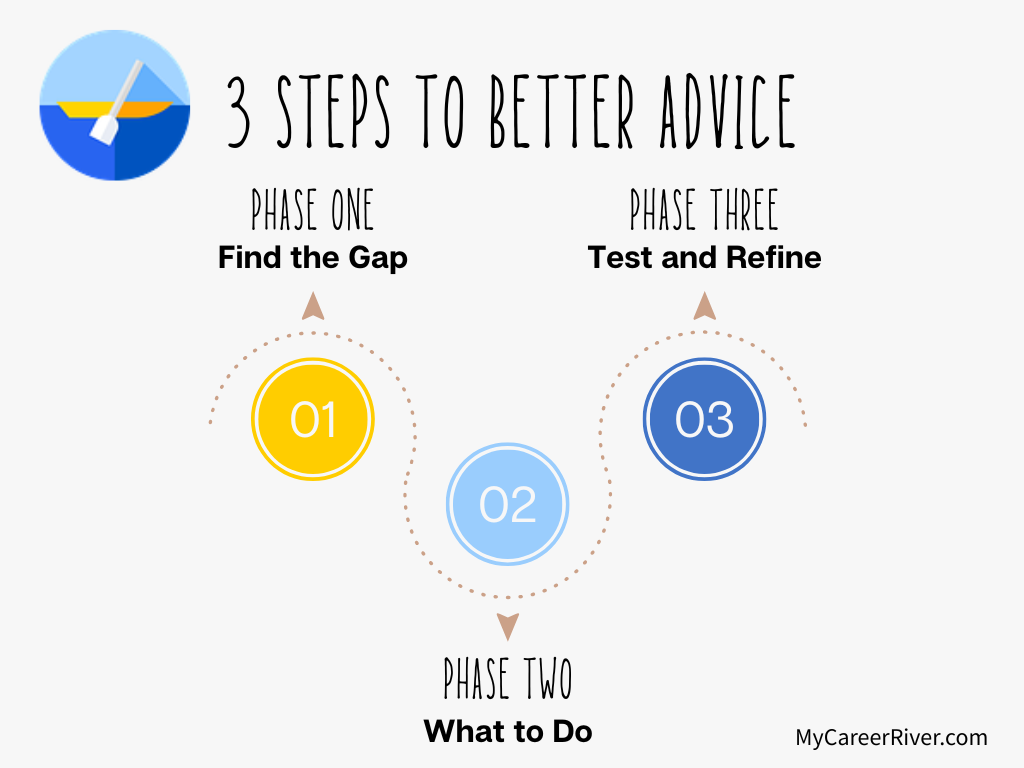
Phase One: Find the Gap
First you need to get a good handle on the problem you're trying to solve – the gap between where you are, and where you want to be. And it has to be specific enough for you to start working on what to do about it.
For my boring article, I knew it was boring as I wrote it. But beyond "make it less boring," I couldn't figure out what to do about it. Writing for Joe and Jane showed me what gap I needed to close.
Phase Two: What to Do
Now you're ready to ask what to do, but not as an open ended question. Ask, "What can I do to (close this gap)?"
You may need to turn to some new people for this one. For instance, maybe you had a long heart-to-heart with a friend from college about why you're feeling stuck at work. And she was able to help you identify the gap, but she doesn't work in your field, so she can't give solid advice about what to try to close it. That's OK!
Different people will be equipped to help with different parts of this process. This is where the Decision Replay can come in handy – find people who faced a similar challenge, and ask them what they did to address it.
Phase Three: Test and Refine
This is optional – it could be the gap you identified was switching companies, and you got some advice about what type of roles to land. If you get the job, boom, you're done.
But if you're in a gray area where you're trying to close the gap but you're not quite sure you're succeeding, this is where test and refine comes in. Reach out again – this could be going back to the original Gap-finder from Phase One, the Tactics-givers from Phase Two, or someone entirely new: the Tester. Give them some guidelines: "I was trying to (this), on a scale of 0 to 5, how well do you think I did? What could I do to improve?"
This is where the Three-Phase approach differs from traditional advice: follow-up. You bring in fresh eyes to evaluate what you're working on and help you get that last little push you need to finish.
The next time you're facing a career decision, find your Gap-finders, Tactics-Givers and Testers. Bad advice is often a symptom of not having enough information. By broadening your support team, you all have a better chance at success.
Happy navigating,
Bridget
🛶 Career River Connection 🛶
Resources for making your next move